

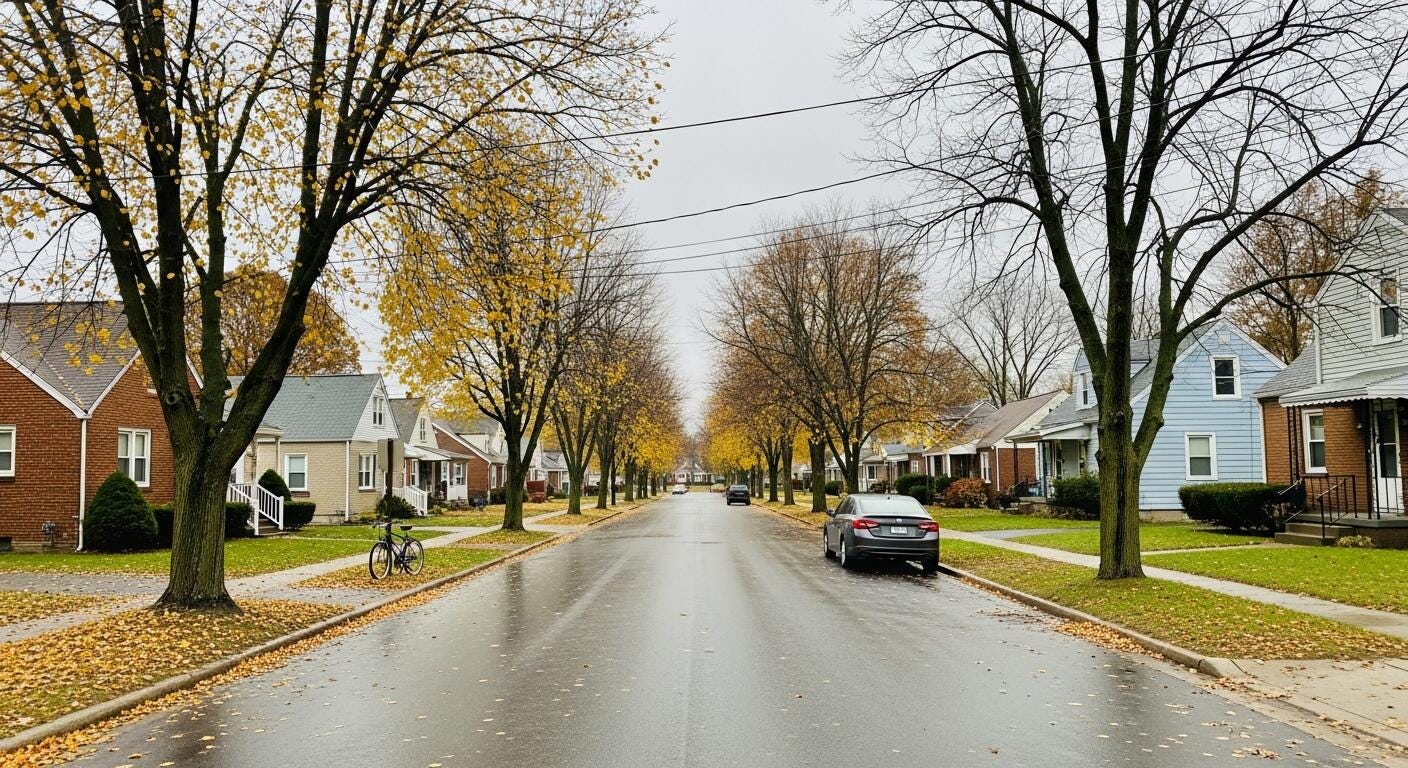
Until 1910 most people in Warren lived in one of these middle sections of the city, but between 1910 and 1970 the city’s population grew six-fold from about 11,000 to over 60,000. This, of course, created high demand for housing. The neighborhoods in the northeastern of our six squares is the most populous. A friend calls it “the land of milk and honey” to reflect its relative affluence.
THE EAST SIDE
The northeast has an entertaining mix of architectural styles: craftsman, midcentury modern, prairie, colonial, Tudor. You’ll find it all here. The lawns are well maintained with many mature trees. (There are mature trees everywhere in Warren.) There are a handful of small parks and a few small shopping areas. Comfortable front porches from which to enjoy a pleasant evening are the rule.
The extreme eastern area is taken up by the Trumbull Country Club, a 1915 brick and stone gathering place for the new country club class. Until maybe 40 years ago Jews and Italians weren’t welcome, but today anyone who can afford the relatively modest dues is welcome. There is a collar a few blocks deep which surrounds the club that contains larger, more expensive homes; not the McMansions one finds out in the burbs; rather older, more modest, but substantial, homes built by the industrialists, doctors and lawyers in the early and mid decades of the 20th century.
Market Street (US82) divides Warren’s north and south sides. Crossing Market to the southeastern section of Warren looks very much the same for a mile or so, and we continue to see an interesting mix of styles and well maintained neighborhoods. Crossing Youngstown Road (US422) into the most southerly section of the east side, the neighborhoods become less affluent. The homes have less brick and more frame. There are more frequent gaps where houses have been demolished, more vacant houses, and more public housing.
THE WEST SIDE
As we slide west we pass over the largely empty Republic Steel acreage into Warren’s southwest side, which is also its most economically challenged. Here there are even more empty lots where houses once stood, and many of those still standing are badly in need of repair and unlikely to ever be economically viable candidates for renovation.
In many parts of Warren you can buy a rough house for $20,000, put $40,000 into it, and have yourself a very nice place for $60,000. Unfortunately, there is a good chance the final product won’t bring $60,000 on the open market. So these properties sit and rot.
In the heart of the southwest side are adjacent vacant lots that aggregate to nearly 100 acres, which once hosted important community institutions. Western Reserve High School was opened in 1967, but by 1990 the population boom that dictated the need for a second city high school had turned into a bust, and the school was closed and demolished.
Westlawn was a 350 unit development of what was supposed to be temporary worker housing constructed during WWII. By the end of the 20th century it had become dangerously run down and was demolished. Westlawn and Western Reserve form a continuous vacant landscape that looks like someone dropped the family farm down in the middle of a city neighborhood.
The northwest quadrant of Warren, the 1st Ward, contains some of Warren’s newest neighborhoods; lots of mid-century ranch homes and split-levels, mixed with older colonials and an eclectic mix of other styles. It was among the last to bloom in Warren’s growth spurt of the ‘50’s and ‘60’s, and among the first to deflate beginning in the ‘80’s. Most of the northwest side remains a well-maintained area because of a strong effort by residents to take care of vacant properties and to patrol their streets in the evenings keeping an eye on unwelcome activities.
Commercial activities have declined, as well, but people come from all over the area for Cockeye BBQ, and its attached creamery selling home made ice cream; the husband, wife and son owners are on a mission to bring the old west side vitality back.